Missing teeth can make eating and smiling feel uncertain, especially if affordability is a major concern for families in San Bernardino. Choosing between dentures and dental implants is not easy, since each option affects comfort and daily habits in different ways. Dentures deliver only 20 percent of the natural biting force according to research, while implants function much closer to real teeth. This article breaks down the differences to help you weigh costs and benefits for a confident, healthy smile.
Table of Contents
- Dental Implants And Dentures Defined Clearly
- Different Types Of Tooth Replacement Options
- Implant And Denture Procedures Step By Step
- Daily Life, Comfort, And Maintenance Factors
- Long-Term Costs And Affordability For Families
- Comparing Benefits, Risks, And Insurance Coverage
Key Takeaways
| Point | Details |
|---|---|
| Dental Implants Offer Advantages | Implants provide stability and functionality akin to natural teeth, enhancing chewing ability and preserving jawbone health. |
| Dentures Are Cost-Effective Initially | While dentures have a lower upfront cost, they require regular replacements and adjustments, which can add to long-term expenses. |
| Consultation Is Essential | A comprehensive consultation with a dental professional is crucial for evaluating the best tooth replacement option based on individual needs and financial considerations. |
| Insurance Coverage Varies | Most dental plans cover dentures but offer limited coverage for implants, leading to significant out-of-pocket costs for patients. |
Dental Implants and Dentures Defined Clearly
Dental restoration options have evolved significantly, offering patients multiple solutions for replacing missing teeth. Dental implants and dentures represent two primary approaches, each with unique characteristics designed to restore oral function and aesthetic appearance.
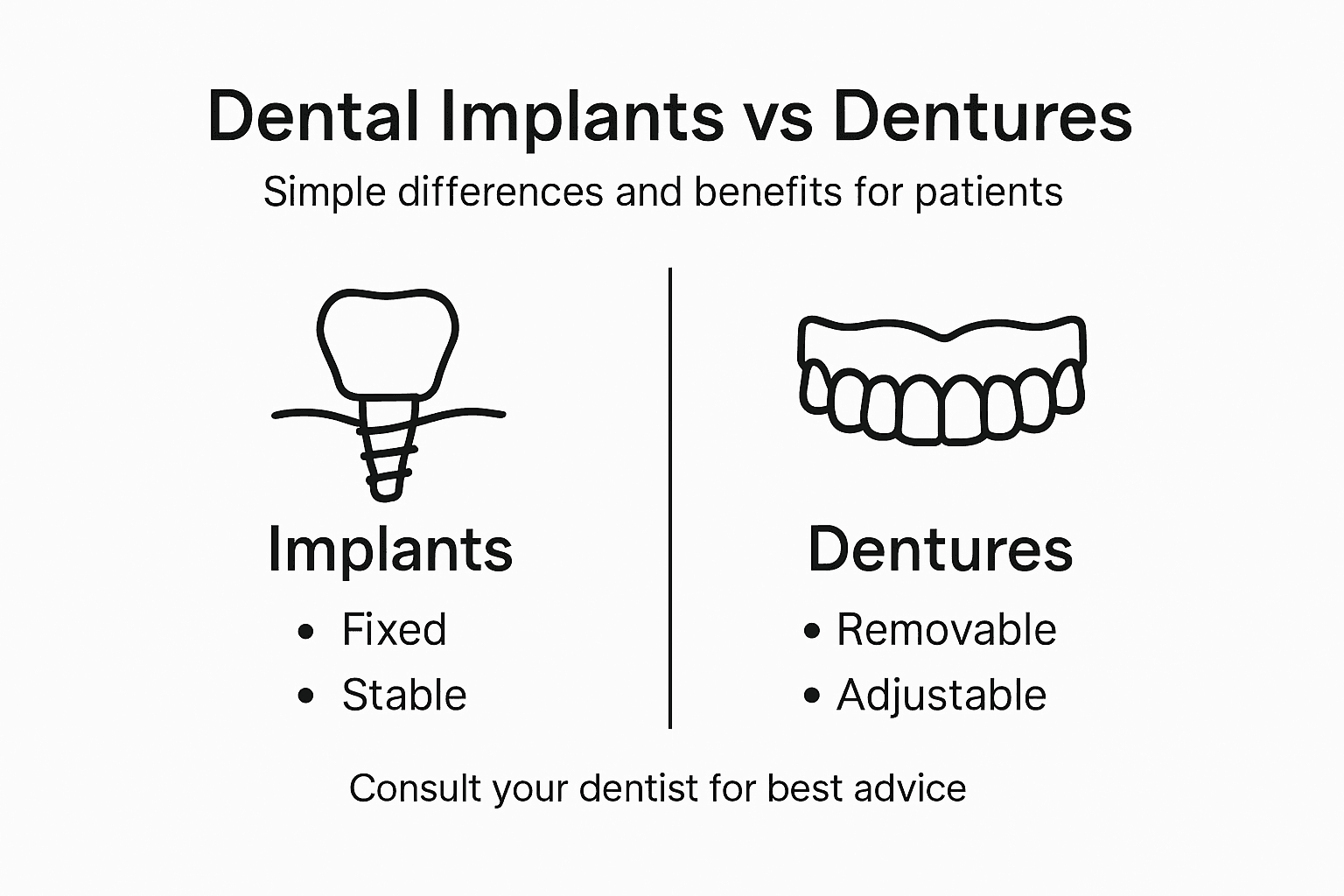
Dentures are removable prosthetic devices supported by gum tissues and designed to replace missing teeth. Dental prosthetic technologies offer two primary configurations:
- Complete dentures: Replace all teeth in upper or lower jaw
- Partial dentures: Replace select missing teeth while preserving remaining natural teeth
In contrast, dental implants provide a more permanent solution. These surgical interventions involve placing titanium posts directly into the jawbone, which act as artificial tooth roots. Dental implants consist of three critical components:
- Titanium post (surgically implanted)
- Abutment connector
- Custom-designed dental crown
Implant technology offers superior functionality compared to traditional dentures. Dental implant research demonstrates that implants provide approximately 90% of natural tooth biting force, significantly outperforming dentures’ 20% capacity.
The fundamental difference lies in their structural approach. Dentures rest on gum surfaces and require regular adjustments and adhesives, while implants integrate directly with bone tissue, creating a more stable and long-lasting solution.
Pro tip: Consult a dental professional to assess your specific oral health needs and determine which restoration option best matches your lifestyle and medical requirements.
Different Types of Tooth Replacement Options
Modern dental technology offers multiple solutions for replacing missing teeth, allowing patients to restore both functionality and aesthetic appearance. Tooth replacement methods have evolved significantly, providing diverse options tailored to individual oral health needs.
Traditional tooth replacement techniques include several primary approaches:
- Removable Partial Dentures: Ideal for patients missing several teeth
- Full Dentures: Complete replacement of upper or lower teeth
- Fixed Bridges: Permanent prosthetics anchored to existing teeth
- Dental Implants: Surgically inserted titanium posts replacing tooth roots
Dental implants represent the most advanced tooth replacement technology. These surgical interventions involve precisely placed titanium posts that integrate directly with jawbone tissue, creating a stable and permanent foundation for artificial teeth. Unlike traditional dentures, implants offer:
- Superior structural stability
- Enhanced chewing functionality
- Preservation of bone density
- Natural aesthetic appearance
Implant-supported solutions provide additional versatility, combining the benefits of traditional dentures with the structural integrity of surgical implants. Patients can choose between removable and fixed options depending on their specific oral health requirements and lifestyle preferences.
The selection process involves careful evaluation of multiple factors, including bone quality, overall oral health, budget constraints, and long-term maintenance considerations. Each tooth replacement method offers unique advantages and potential limitations.
Here’s a side-by-side summary of the major dental restoration methods:
| Method | Core Structure | Durability | Lifestyle Impact |
|---|---|---|---|
| Dental Implants | Titanium post & crown | 20+ years, often lifelong | Closest to natural teeth; minimal changes |
| Dentures | Removable acrylic base | 5-7 years, needs replacement | Requires adaptation, removable nightly |
| Fixed Bridges | Anchored to real teeth | 10-15 years | Permanent, affects neighboring teeth |
| Implant-supported Dentures | Implant base with removable teeth | 10+ years | Increased stability; easier cleaning |
Pro tip: Schedule a comprehensive dental consultation to thoroughly assess your specific tooth replacement needs and determine the most suitable restoration approach for your individual circumstances.
Implant and Denture Procedures Step by Step
Dental restoration involves complex and personalized procedures tailored to individual patient needs. Dental implant surgical techniques require multiple stages of careful planning and execution to ensure successful tooth replacement.
The dental implant procedure typically encompasses several critical stages:
- Initial Consultation: Comprehensive oral health assessment
- Diagnostic Imaging: 3D scans and X-rays to evaluate bone structure
- Treatment Planning: Customized approach based on individual anatomy
- Surgical Preparation: Potential bone grafting or tissue conditioning
Implant placement involves a precise surgical intervention:
- Titanium post insertion into jawbone
- Healing period for osseointegration (3-6 months)
- Abutment attachment
- Custom crown fabrication and placement
Denture procedures follow a different yet equally methodical approach. Prosthetic development requires multiple precision steps, including:
- Detailed oral impressions
- Custom prosthetic design
- Fitting and adjustment appointments
- Patient adaptation and comfort optimization
Surgical complexity varies depending on individual patient requirements. Some patients might require additional preparatory procedures like bone grafts or sinus lifts to ensure optimal implant stability and long-term success.
Pro tip: Request a comprehensive digital imaging consultation to understand your specific anatomical considerations and potential procedural requirements.
Daily Life, Comfort, and Maintenance Factors
Dental restoration options dramatically impact daily lifestyle and oral health maintenance. Dental prosthetic care requires understanding the unique maintenance requirements for different tooth replacement solutions.
Denture maintenance involves several critical considerations:
- Daily cleaning with non-abrasive cleansers
- Removal at night for gum tissue rest
- Regular dental check-ups
- Potential use of dental adhesives
- Managing initial adaptation period
Implant maintenance offers a more permanent and straightforward approach:
- Brush and floss like natural teeth
- Use specialized interdental cleaning tools
- Schedule regular professional cleanings
- Monitor for potential peri-implantitis signs
Comfort levels vary significantly between dentures and implants. Dentures may initially cause:
- Increased saliva production
- Potential sore spots
- Speech adjustment challenges
- Periodic fit modifications
Lifestyle integration requires patience and consistent care. Dental implants generally provide more stable and comfortable long-term solutions, mimicking natural tooth functionality and requiring similar maintenance routines.

Pro tip: Invest in specialized cleaning tools and maintain a consistent oral hygiene routine to maximize the longevity and comfort of your dental restoration.
Long-Term Costs and Affordability for Families
Dental restoration represents a significant financial investment for families seeking to replace missing teeth. Dental implant costs vary dramatically, with substantial long-term financial considerations beyond initial treatment expenses.
The financial breakdown for dental restoration options reveals complex pricing structures:
- Single Dental Implant: Approximately $4,200 average cost
- Complete Denture Set: Less expensive initial investment
- Replacement Frequency: Dentures need replacement every 5-7 years
- Implant Longevity: Potential lifetime durability with proper care
Cost comparison between implants and dentures demonstrates critical financial differences:
- Upfront investment for implants: $3,000 - $6,000 per tooth
- Additional potential expenses for implants:
- Bone grafting procedures
- Surgical extractions
- Specialized imaging
- Denture ongoing maintenance costs
Insurance coverage typically provides limited financial support. Most dental insurance plans have annual maximums significantly lower than comprehensive implant treatment costs, leaving patients responsible for substantial out-of-pocket expenses.
Financial strategies can help manage dental restoration expenses:
Compare the long-term cost and insurance aspects below:
| Option | Upfront Cost | Replacement Cycle | Typical Insurance Support |
|---|---|---|---|
| Dental Implants | $3,000-$6,000 per tooth | Rare, lifelong if maintained | Often limited, high out-of-pocket |
| Dentures | $1,000-$3,000 full set | Every 5-7 years | Usually covered, some copay required |
| Bridges | $2,000-$5,000 per bridge | 10-15 years | Partial coverage, varies by plan |
| Implant Dentures | $4,000-$8,000 | 10+ years | Minimal coverage, financing recommended |
- Dental savings plans
- Flexible financing options
- Payment plan arrangements
- Health savings account contributions
Pro tip: Request a comprehensive cost consultation that includes long-term maintenance expenses to develop a realistic financial planning strategy for your dental restoration.
Comparing Benefits, Risks, and Insurance Coverage
Understanding the comprehensive landscape of dental restoration requires careful evaluation of benefits, potential risks, and insurance considerations. Dental insurance complexities significantly impact patient decision-making for tooth replacement options.
Insurance Coverage Breakdown:
- Dentures typically covered by most dental plans
- Partial and full denture coverage with varying copayments
- Limited or no coverage for dental implants
- Significant out-of-pocket expenses for implant procedures
Benefits comparison between dentures and implants reveals distinct advantages:
-
Dental Implants Benefits:
- Permanent solution
- Jawbone preservation
- Natural tooth functionality
- Improved long-term oral health
-
Dentures Benefits:
- Lower initial cost
- Non-surgical approach
- Faster treatment timeline
- Easier replacement
Potential Risks associated with each option include:
-
Implant Risks:
- Surgical complications
- Potential bone rejection
- Higher initial procedure complexity
- Extended healing period
-
Denture Risks:
- Frequent adjustments
- Potential gum irritation
- Limited chewing functionality
- Regular replacement requirements
Pro tip: Request a detailed insurance consultation to understand specific coverage limitations and out-of-pocket expenses for your preferred dental restoration option.
Discover the Best Solution for Your Smile at Monteluz Dental Specialty Group
Choosing between dental implants and dentures is a critical decision that impacts your oral health, comfort, and lifestyle. Whether you face challenges like adapting to removable dentures or seek the long-lasting stability of dental implants, understanding your options is the first step toward restoring your confident smile. This article highlights important pain points like maintenance routines, implant durability, and insurance coverage, all key to making an informed choice.
At Monteluz Dental Specialty Group, we specialize in personalized dental implant procedures and denture solutions designed to meet your unique needs. With our patient-centered approach, bilingual support, and flexible financing options, we help eliminate barriers to accessing quality care in San Bernardino and the Inland Empire. Learn more about comprehensive dental care and restoration options by exploring our Monteluz Dental Specialty Group for expert guidance tailored to your journey.
Take control of your dental future now by scheduling a consultation with Monteluz Dental Specialty Group. Visit Monteluz Dental Specialty Group to explore treatment options and insurance plans that fit your budget and lifestyle. Your new smile is just a click away.
Frequently Asked Questions
What are the main differences between dental implants and dentures?
Dental implants are permanent fixtures that involve surgically placing titanium posts into the jawbone, while dentures are removable prosthetic devices that rest on the gums. Implants provide better functionality and stability compared to dentures, which require regular adjustments and can be less stable.
How long do dental implants and dentures typically last?
Dental implants can last a lifetime with proper care, while dentures generally need to be replaced every 5-7 years. The longevity of both options depends on maintenance and individual oral health conditions.
What are the maintenance requirements for implants and dentures?
Dental implants require routine brushing and flossing like natural teeth, along with regular dental check-ups. Dentures need daily cleaning, removal at night, and occasional adjustments for comfort and fit.
Are dental implants worth the investment compared to dentures?
While dental implants have a higher upfront cost, they often last longer and provide superior functionality and comfort, making them a worthwhile investment for many patients compared to the recurring expenses associated with dentures.