
TL;DR:
- Flexible dental financing makes expensive procedures like implants more affordable through manageable monthly payments.
- Compared to insurance and membership plans, financing offers greater approval flexibility and covers procedures often not fully insured.
- Understanding interest rates, fees, and total repayment ensures patients choose transparent plans that suit their budgets.
A single dental implant can cost around $4,000 on average, and that number alone stops many Inland Empire families from getting the care they need. The good news is that flexible dental financing has quietly changed what’s possible for patients who once thought specialty treatment was out of reach. Whether you need an implant to replace a missing tooth or an urgent root canal, modern payment options can break that cost into manageable monthly amounts. In this article, we walk you through how dental financing works, how it stacks up against insurance and membership plans, and exactly what to check before you sign anything.
Table of Contents
- Understanding flexible dental financing
- Comparing financing, insurance, and membership plans
- Flexible financing for specialty dental care: Real-world scenarios
- Key factors to evaluate before choosing a dental financing plan
- Our perspective: Why transparent financing is changing dental care
- Get started with affordable dental care options
- Frequently asked questions
Key Takeaways
| Point | Details |
|---|---|
| Flexible plans increase access | Financing choices make it possible for more families to pursue necessary dental treatments without delay. |
| Compare all payment options | Look at insurance, membership, and financing side by side to find the best fit for your budget and care needs. |
| Always review total costs | Check both the monthly payment and the overall amount owed to avoid surprises. |
| Specialty care is within reach | Implants and root canals can be affordable thanks to high-approval, low-monthly financing solutions. |
Understanding flexible dental financing
Flexible dental financing is a payment arrangement that lets you receive dental treatment now and pay for it over time, usually through a third-party lender or a buy-now-pay-later (BNPL) provider. Instead of handing over a large lump sum at the appointment, you’re approved for a credit line or installment plan that spreads the cost across months or years. Think of it like financing a car, but for your teeth.
Most dental financing plans fall into two categories. The first is traditional installment credit, offered through providers like CareCredit or Lending Club. These typically require a credit check and offer promotional periods with 0% APR (annual percentage rate, meaning no interest charged) for qualified applicants. The second is BNPL, offered through platforms like Cherry, which often approve patients with lower credit scores and focus on fast, same-day decisions.
Here’s a quick look at how monthly payments might break down for common specialty treatments:
| Treatment | Estimated Cost | Monthly Payment (0%, 24 mo) | Monthly Payment (0%, 12 mo) |
|---|---|---|---|
| Single dental implant | $3,400 | ~$142 | ~$283 |
| Full-arch implants | $20,000 | ~$833 | ~$1,667 |
| Root canal (molar) | $1,200 | ~$50 | ~$100 |
| Root canal + crown | $2,200 | ~$92 | ~$183 |
One of the most important findings in recent dental research is that treatment acceptance rises significantly when financing is available. Patients who might otherwise delay or skip necessary care are far more likely to move forward when they see a monthly number instead of a total. You can explore your dental financing options and see what fits your situation before your first appointment.
For a deeper look at how installment plans work for specific procedures, a flexible payment plan guide breaks down the mechanics clearly.
Pro Tip: Always calculate the total repayment amount, not just the monthly payment. A low monthly figure can sometimes hide a longer term or deferred interest that adds up fast.
Comparing financing, insurance, and membership plans
With a clear understanding of financing, it’s crucial to see how it compares to traditional payment options like insurance and newer solutions such as membership programs.
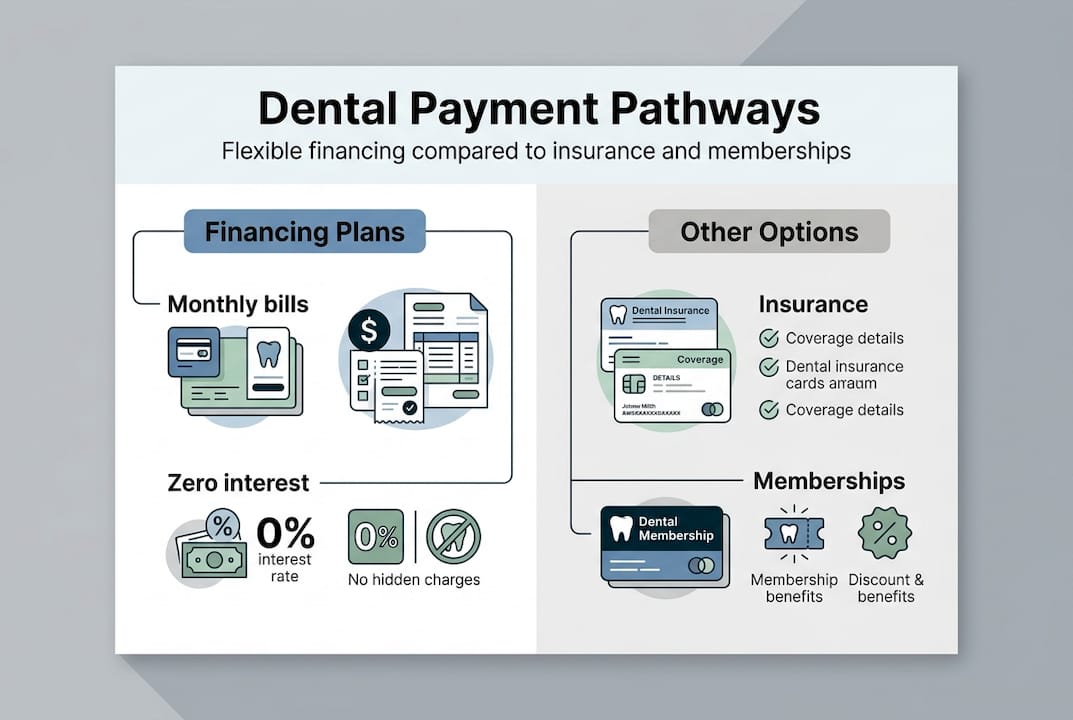
Dental insurance is the most familiar option, but it has real limits for specialty care. Most PPO plans cover root canals at around 50% of the cost, but they cap annual benefits between $1,000 and $2,500. For implants, coverage is even spottier. Many plans classify implants as cosmetic or exclude them outright. As a result, insurance covers partial costs, often leaving patients with thousands still owed out of pocket.
Financing fills that gap. A 0% APR plan or BNPL option can cover what insurance won’t, letting you start treatment without waiting to save the remainder. You can review our implant financing guide to see how this works for implant cases specifically.
Membership plans are a third path, especially valuable for uninsured families. These programs charge a monthly or annual fee in exchange for reduced rates on services. Our affordable membership plans start at just $20 per month and can meaningfully lower your out-of-pocket costs before financing even enters the picture.
Here’s how the three options compare side by side:
| Factor | Financing | Dental insurance | Membership plan |
|---|---|---|---|
| Approval required | Yes (credit check or soft pull) | Yes (enrollment period) | No |
| Covers implants | Yes (full cost) | Rarely or partially | Discount only |
| Monthly cost | Varies by plan | $30 to $60+ per month | From $20/month |
| Immediate access | Yes | Waiting periods may apply | Yes |
| Flexibility | High | Low | Medium |
Key takeaways for families evaluating their options:
- Insurance works best when your procedure falls within covered categories and annual maximums.
- Financing is ideal when costs exceed what insurance covers or when you have no insurance at all.
- Membership plans reduce the base cost, making financing even more manageable when combined.
For families navigating insurance for implants, understanding these limits upfront prevents surprises later.
Flexible financing for specialty dental care: Real-world scenarios
Now that we’ve compared the main payment options, let’s walk through how financing changes the game for typical families needing big-ticket dental procedures.
Scenario 1: A $3,400 implant, paid in 24 months
- Patient visits Monteluz Dental for a consultation on a missing molar.
- The cost factors for implants are reviewed, and the total comes to $3,400 including the post, abutment, and crown.
- Patient applies for a 0% APR financing plan through the office. Approval takes about 10 minutes.
- Monthly payment is set at approximately $142 for 24 months with no interest.
- Treatment begins the same week. The patient keeps their monthly budget intact.
This scenario is common, and the math works because the total paid equals the original cost. No interest means no penalty for spreading it out.

Scenario 2: An urgent root canal with BNPL approval
A parent comes in with a severely infected molar. The procedure needs to happen that day. Traditional financing might take longer to process, but BNPL options like Cherry are designed for exactly this situation. Approval is fast, credit requirements are flexible, and the patient can start treatment immediately. The key caution here is that some BNPL plans carry high APRs after a promotional period, so modeling the total repayment is critical.
“Patients who understand their payment options before they sit in the chair are far more likely to complete their full treatment plan, leading to better long-term outcomes.” — Patient financial planning research, 2025
Before your appointment, reviewing the dental implant checklist for California can help you prepare both clinically and financially.
Pro Tip: For urgent care situations, ask the office about same-day BNPL approval before your appointment. Knowing your options in advance removes one major stressor when you’re already in pain.
Key factors to evaluate before choosing a dental financing plan
After seeing how financing plays out in specific cases, it’s important to know what to look for and what to avoid before signing up.
Not all financing plans are created equal. Some look attractive on the surface but carry terms that cost you more in the long run. Here’s what to review carefully:
- Interest rate and APR: Is the 0% rate promotional? If so, what does it jump to after the promo period ends? Deferred interest plans can retroactively charge interest on the full original balance if you don’t pay it off in time.
- Origination or processing fees: Some lenders charge a setup fee that adds to your total cost. Ask for the full fee disclosure before agreeing.
- Approval terms: What credit score is needed? Will the application trigger a hard credit inquiry that affects your score?
- Prepayment penalties: Can you pay the balance off early without a fee? Most patient-focused plans allow this, but confirm it in writing.
- Missed payment consequences: What happens if you miss a payment? Some plans convert from 0% to a high interest rate immediately.
For families who are new to dental credit, reviewing dental insurance terms can also help you understand the broader financial landscape before committing.
The most important step is modeling your total repayment. A plan offering $125 per month for a $3,000 implant over 24 months at 0% means you pay exactly $3,000. But a plan with 19.99% APR after month 12 could add hundreds more. Run the numbers, not just the monthly figure.
A detailed financing considerations guide can walk you through the questions to ask before you commit to any plan.
Our perspective: Why transparent financing is changing dental care
We’ve seen firsthand what happens when families finally understand their payment options. Patients who had been living with a missing tooth for years, or tolerating a painful tooth because they assumed they couldn’t afford treatment, move forward with confidence once the numbers are laid out clearly.
The uncomfortable truth is that traditional payment models have left too many people behind. High upfront costs, confusing insurance language, and a lack of alternatives have kept underserved communities in the Inland Empire from accessing care they genuinely need. Transparent financing changes that dynamic.
What we see working best in real practice is simple: when patients know the full cost, the monthly payment, and the total they’ll repay before they commit, trust goes up and treatment happens. Opacity is the enemy of good dental health. We believe easier treatment access isn’t a luxury feature. It’s the baseline standard every family deserves.
Get started with affordable dental care options
If you’re ready to take advantage of flexible financing for your family’s dental needs, here’s how to get started. At Monteluz Dental Specialty Group, we offer advanced dental implant options and trusted root canal expertise with financing built into the patient experience from day one.
We’ll walk you through a personalized financing consultation so you know exactly what to expect before treatment begins. If you’re uninsured, our affordable membership plans starting at $20 per month can reduce your costs right away. Call us or request an appointment online. Our bilingual team is ready to help you find a path to care that fits your family’s budget and timeline.
Frequently asked questions
Are there flexible dental financing options if I have bad credit?
Yes, many dental offices use providers that approve patients with less-than-perfect credit, though rates and terms may vary. BNPL providers like Cherry are specifically designed for patients who need fast approval with flexible credit requirements.
Does dental insurance cover implants or root canals?
Dental insurance may partially cover these procedures, but typically only up to 50 percent and with annual caps between $1,000 and $2,500. Many plans exclude implants entirely, making financing or membership plans a necessary complement.
How do monthly dental payments work for expensive treatments?
Monthly payment plans let you break major costs into smaller, predictable payments, often with 0% promotional periods for qualified applicants. For example, a 0% plan for 24 months on a $3,000 implant comes to about $125 per month with no added interest.
Can I combine financing with dental membership savings?
Yes, some offices allow you to apply membership plan discounts first and then finance the remaining out-of-pocket balance, which can make monthly payments even more manageable.
Is there a penalty for paying off my financing plan early?
Most patient-focused plans allow early payoff without a penalty, but always review the prepayment terms in writing before signing to avoid unexpected fees.
Recommended
- Affordable Dental Care – Impact on Family Well-being
- Financiamiento Dental Asequible: Soluciones Para Familias
- Affordable Dental Care Workflow for Families Near You
- Dental Financing Options Explained: 30% More Treatment Access
- Bridge Financing - Miracle Financial