Many families believe affordable dental coverage means settling for limited care or facing unexpected costs. That misconception keeps people from exploring HMO dental plans, which actually deliver comprehensive coverage at lower premiums than traditional options. In 2026, understanding how HMO dental plans work empowers you to make smart decisions about your family’s oral health. This guide breaks down what HMO dental plans offer, how they save money in San Bernardino and the Inland Empire, and practical steps to choose the right plan for your needs.
Table of Contents
- What Is An HMO Dental Plan?
- How HMO Dental Plans Save You Money In San Bernardino And The Inland Empire
- Understanding Coverage And Limitations Of HMO Dental Plans
- How To Choose The Right HMO Dental Plan And Make The Most Of It
- Explore Affordable Specialist Dental Care In San Bernardino
- Frequently Asked Questions
Key takeaways
| Point | Details |
|---|---|
| Lower monthly premiums | HMO dental plans cost 20-50% less than PPO plans, fitting tighter family budgets. |
| Fixed copayments | You pay predictable amounts for each service, making budgeting straightforward. |
| No deductibles | Start using coverage immediately without paying upfront costs before services. |
| Network requirements | You must choose a primary dentist within the plan’s network for coverage. |
| Preventive care savings | Routine exams and cleanings typically have $0 copays when visiting in-network providers. |
What is an HMO dental plan?
An HMO dental plan, often called a DHMO, requires you to select a primary care dentist from a specific network of providers. This network structure keeps costs lower because the insurance company negotiates rates with participating dentists. You must visit in-network providers for coverage, except in emergency situations where immediate care is necessary.
Monthly premiums stay significantly lower than traditional PPO plans because of these network restrictions. Instead of paying percentages or coinsurance after meeting a deductible, you pay fixed copayments for services. A cleaning might cost $0, a filling $30, and a crown $300, giving you clear expectations before each appointment.
Most DHMO plans have no deductibles and no waiting periods. This means you can schedule that root canal or filling the day your coverage starts without paying hundreds of dollars upfront. For families in San Bernardino and the Inland Empire managing tight budgets, this immediate access removes a major barrier to getting necessary dental care.
The network model works because participating dentists agree to accept lower reimbursement rates in exchange for a steady stream of patients. You benefit from these negotiated rates through lower premiums and predictable copayments. Think of it like a membership club where everyone gets discounted prices because the group negotiated better deals.
Key features of HMO dental plans:
- Primary care dentist selection required from network providers
- Fixed copayments instead of percentage-based coinsurance
- Lower monthly premiums compared to PPO alternatives
- No deductibles to meet before coverage begins
- No waiting periods for most services
- Specialist referrals typically required from primary dentist
Pro Tip: Before enrolling, verify that your preferred dentist participates in the HMO network, or research participating providers in your area to ensure convenient access to quality care.
Understanding these fundamentals helps you evaluate whether an HMO dental plan matches your family’s needs. The benefits of HMO dental in California become clearer when you compare actual costs and coverage details against your current situation.
How HMO dental plans save you money in San Bernardino and the Inland Empire
The most immediate savings come from monthly premiums 20-50% lower than PPO plans. A family paying $180 monthly for PPO coverage might pay just $90 to $120 for comparable HMO coverage. Over a year, that difference adds up to $720 to $1,080 in savings, money that stays in your household budget for other priorities.

Fixed copayments create predictable expenses that make budgeting simpler. When you know a filling costs exactly $30 and a cleaning costs $0, you can plan dental visits without fear of surprise bills. Copayments for exams and cleanings range from $0 to $30 in most HMO plans, with many offering completely free preventive care when you visit in-network providers.
Eliminating deductibles removes another financial barrier. Traditional PPO plans often require you to pay $50 to $150 out of pocket before coverage kicks in. HMO plans let you use your benefits immediately, which matters tremendously when your child needs an urgent filling or you’re dealing with tooth pain that requires quick treatment.
Typical HMO dental plan costs:
| Service Type | Average HMO Copayment | Typical PPO Cost |
|---|---|---|
| Routine exam | $0 | $50-$100 |
| Cleaning | $0 | $75-$150 |
| Filling | $30 | $100-$250 |
| Root canal | $300 | $800-$1,200 |
| Crown | $400 | $1,000-$1,500 |
For families in San Bernardino and the Inland Empire where affordable dental care is a priority, these savings make comprehensive oral health achievable. You can schedule regular preventive visits without worrying about the financial impact, which actually prevents more expensive problems down the road.
The combination of lower premiums, fixed copayments, and no deductibles creates a triple advantage. You pay less every month, know exactly what each visit costs, and start using benefits immediately. This structure particularly benefits families with children who need regular checkups and occasional fillings or orthodontic evaluations.
Additional cost advantages:
- No annual maximums on most plans means unlimited coverage
- Preventive care incentives encourage regular visits
- Predictable budgeting reduces financial stress
- Immediate coverage eliminates waiting period expenses
Pro Tip: Calculate your family’s annual dental costs under your current plan versus an HMO option. Include premiums, deductibles, and typical service costs to see real savings potential.
Choosing an HMO dental plan empowers you to prioritize your family’s oral health without sacrificing other budget priorities. The in-house dental membership impact can complement HMO coverage for services not fully covered, creating even more comprehensive protection. Understanding the importance of dental insurance helps you appreciate how HMO plans deliver genuine value through strategic cost management.
Understanding coverage and limitations of HMO dental plans
Most preventive services have a $0 copay when you visit in-network providers. This includes routine oral exams, cleanings, fluoride treatments, and X-rays. Taking advantage of these free services twice yearly helps catch problems early when they’re less expensive to treat, making preventive care the smartest investment in your oral health.
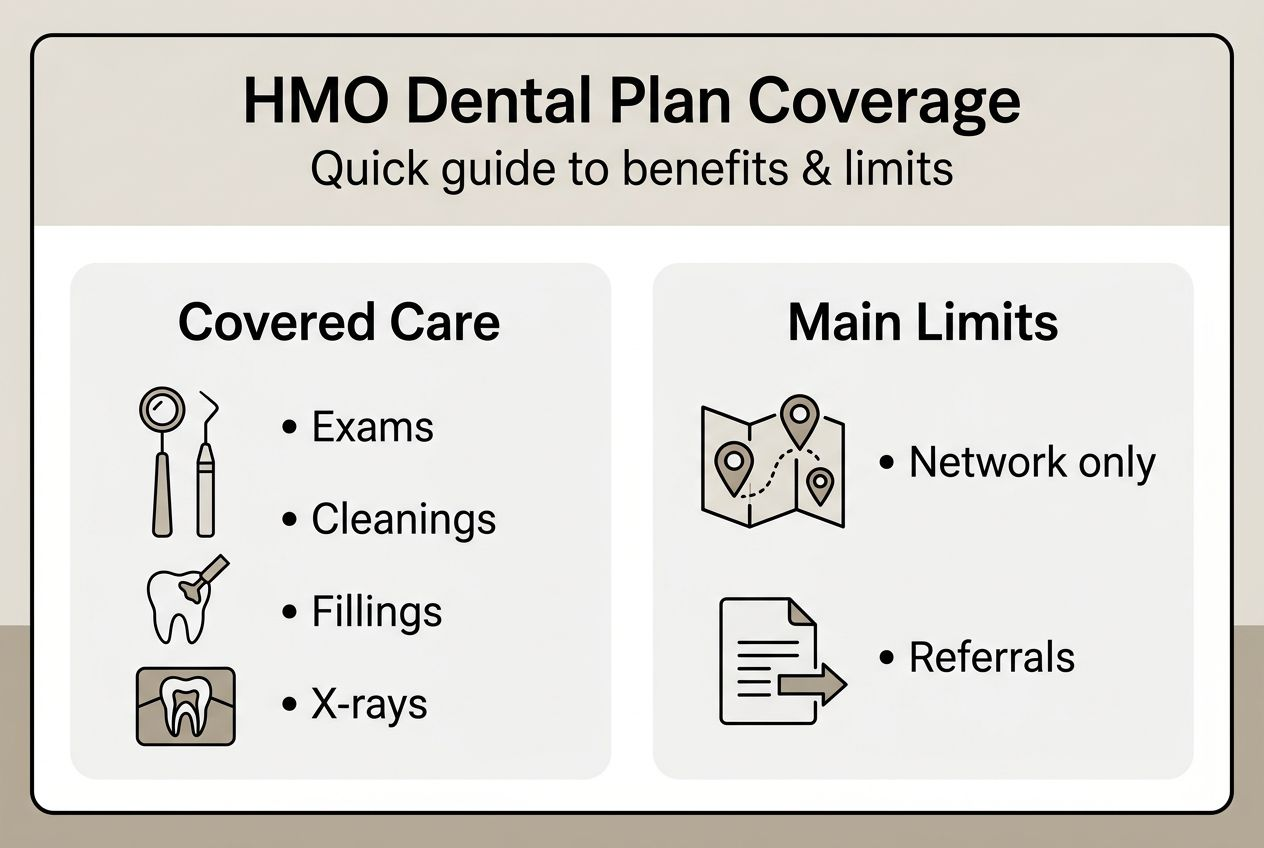
Basic services carry fixed copayments that vary by procedure complexity. A simple filling might cost $30, a tooth extraction $65, and a root canal $300. These predictable costs let you plan for necessary treatments without financial surprises. Major services like crowns typically cost $400 to $600, still significantly less than PPO out-of-pocket expenses.
The DeltaCare USA Family Dental HMO plan demonstrates typical coverage structure with no deductible, no waiting periods, and no annual or lifetime maximums for dental and orthodontia services. This means you never hit a coverage limit that forces you to pay full price for treatments. Whether you need $500 or $5,000 in dental work this year, your plan continues covering services at the same copayment rates.
Common HMO dental plan copayments:
| Service Category | Typical Copayment Range | Coverage Notes |
|---|---|---|
| Preventive care | $0 | Exams, cleanings, fluoride, X-rays |
| Basic restorative | $30-$100 | Fillings, simple extractions |
| Endodontics | $200-$400 | Root canals, pulp therapy |
| Major restorative | $400-$700 | Crowns, bridges, dentures |
| Orthodontics | $1,500-$2,500 | Braces, aligners (if covered) |
Network restrictions represent the main limitation. You must receive care from participating dentists, and switching providers typically requires formal notification to your insurance company. Emergency care outside the network receives coverage, but routine services performed by non-participating dentists result in full out-of-pocket costs.
Referral requirements add another layer of process. Your primary dentist coordinates all care, including referrals to specialists for procedures like oral surgery or orthodontics. While this coordination ensures continuity of care, it means you can’t directly schedule with a specialist without your primary dentist’s approval.
Important coverage considerations:
- In-network care required for coverage (except emergencies)
- Primary dentist coordinates all specialty referrals
- No annual maximums means ongoing coverage
- Cosmetic procedures typically excluded
- Orthodontic coverage varies by plan
The dental membership program guide offers alternatives for services not covered by HMO plans, creating comprehensive protection. Following oral health tips for San Bernardino families maximizes your plan benefits by preventing problems that require more expensive treatments.
Understanding these coverage details and limitations helps set realistic expectations. You get excellent value for preventive and basic care with predictable costs, but you must work within the network structure and follow referral processes for specialized services.
How to choose the right HMO dental plan and make the most of it
Start by evaluating network dentists in your area to ensure convenient access to quality providers. Check online reviews, ask for recommendations from friends and family, and verify that participating dentists have convenient office hours and locations. A great plan loses value if the nearest in-network dentist is 30 miles away or has a three-month wait for appointments.
Compare fixed copayment amounts across different HMO plans for procedures your family commonly needs. If your children frequently need fillings, a plan with $25 copays beats one charging $50 per filling. If you’re planning orthodontic treatment, verify coverage details and copayment structures for braces or aligners before enrolling.
Verify that your chosen plan includes no waiting periods and no deductibles to avoid upfront expenses. Some plans impose waiting periods for major services like crowns or root canals, which delays necessary care and creates financial uncertainty. Plans without these restrictions deliver immediate value.
Steps to select your ideal HMO dental plan:
- Research participating dentists in San Bernardino and Inland Empire areas
- Compare copayment schedules for services you anticipate needing
- Verify coverage for specialty services like orthodontics or implants
- Confirm no waiting periods for major procedures
- Check emergency care provisions for out-of-network situations
- Review annual premium costs against potential savings
Schedule regular preventive visits to maximize your $0 copay benefits and catch problems early. Dentists can identify cavities, gum disease, and other issues before they require expensive treatments. Two cleanings and exams yearly cost you nothing but save hundreds or thousands in avoided restorative work.
Understand your plan’s referral process for specialist care. Know whether you need written authorization from your primary dentist before seeing an endodontist or oral surgeon. Clarify how emergency situations work, including what qualifies as an emergency and how to access care outside regular business hours.
Pro Tip: Keep your insurance card and primary dentist’s contact information easily accessible. When dental emergencies happen, quick access to this information speeds up care and ensures proper coverage.
Maximizing HMO dental plan value requires active participation. Ask your dentist about preventive treatments that might avoid future problems. Request treatment plans with cost estimates before major procedures. Stay current with recommended preventive visits to maintain optimal oral health while taking full advantage of your coverage.
The affordable dental care steps complement your HMO plan by addressing gaps in coverage or providing additional savings options. Understanding why dental insurance matters motivates consistent use of your benefits rather than letting coverage go unused.
Explore affordable specialist dental care in San Bernardino
If you have or are considering an HMO dental plan, Monteluz Dental Specialty Group offers affordable specialist care perfect for families in San Bernardino and the Inland Empire. Our practice accepts HMO insurance plans and provides comprehensive services that complement your coverage, ensuring your family receives complete oral health care.
Explore our affordable dental membership plans starting at just $20 monthly to complement your insurance and gain additional savings on specialty services. Our endodontic specialists provide expert root canal therapy with predictable pricing, while our dental implants options restore missing teeth with personalized treatment plans. Visiting trusted local specialists ensures your family’s oral health needs are met comprehensively, combining insurance benefits with accessible specialty care.
Frequently asked questions
What dental services are typically covered by HMO dental plans?
HMO dental plans cover preventive services like exams, cleanings, and X-rays at $0 copay, plus basic restorative work including fillings and extractions. Most plans also cover major services like root canals, crowns, and dentures at fixed copayments, with some offering orthodontic coverage for children and adults.
How do copayments work in an HMO dental plan?
You pay a predetermined fixed amount for each service when you visit your in-network dentist. These copayments are listed in your plan documents, so you know exactly what a filling, crown, or root canal costs before your appointment. This predictability helps you budget for dental care without surprise bills.
Can I switch dentists if I don’t like my assigned provider?
Yes, you can change your primary care dentist within the HMO network by notifying your insurance company. Most plans allow changes monthly or quarterly, though timing varies by insurer. Check your plan documents for specific procedures and any waiting periods between changes.
Are there waiting periods to use dental coverage under HMO plans?
Most HMO dental plans have no waiting periods, letting you use coverage immediately for preventive, basic, and major services. This contrasts with many PPO plans that impose 6 to 12 month waiting periods for major procedures like crowns or root canals.
How do HMO dental plans differ from PPO plans?
HMO plans require choosing a primary dentist from a specific network and have lower premiums with fixed copayments, while PPO plans offer broader provider choice with higher premiums and percentage-based coinsurance. HMO plans typically have no deductibles or annual maximums, whereas PPO plans often include both. The choice depends on whether you prioritize cost savings or provider flexibility.
Recommended
- Beneficios del HMO Dental para Familias en California
- Dental Membership Plans: Affordable Options for Uninsured
- Dental Membership Program Guide for Affordable Family Care
- Cómo aprovechar beneficios dentales HMO para tratamientos especializados