TL;DR:
- Understanding your insurance type and needs helps filter local dental providers effectively.
- Reliable resources like state directories and patient reviews are essential to find trustworthy dentists.
- Building a trusting relationship with your dentist based on communication and care quality ensures better oral health outcomes.
Navigating dental care in the Inland Empire can feel like solving a puzzle with missing pieces, especially when you’re juggling insurance options, family needs, and tight budgets. Whether you’re covered by Denti-Cal/Medi-Cal, carrying private insurance, or currently uninsured, the right dentist is out there for you. This guide walks you through every step, from understanding your coverage to reading reviews and confirming your choice. We’ve built this framework specifically for Inland Empire families and individuals who want quality care without the confusion or the financial stress.
Table of Contents
- Understand your dental coverage and needs
- Use trusted resources to find local dentists
- Evaluate services and verify affordability
- Check reviews and make your decision
- A fresh perspective: What truly matters when picking a dentist in Inland Empire
- Affordable care options in Inland Empire: Next steps
- Frequently asked questions
Key Takeaways
| Point | Details |
|---|---|
| Assess your coverage | Know your insurance, membership, or payment options before searching for a dentist. |
| Use official provider tools | Always start your search with trusted sources to find up-to-date local dentists. |
| Verify services and costs | Call offices to confirm services offered and ask about discounts for uninsured patients. |
| Check real reviews | Read honest patient feedback and call with questions before making your final choice. |
Understand your dental coverage and needs
Before you search for a single provider, you need a clear picture of your insurance status and what services you actually need. This step alone saves you from wasted calls and disappointing visits. Think of it as running a quick diagnostic before making any move.
There are three main coverage situations most Inland Empire patients fall into:
- Denti-Cal/Medi-Cal: California’s public dental program covers eligible low-income adults and children. Services vary by age group, so confirm what’s included for each family member.
- Private insurance (PPO or HMO): These plans have networks, annual maximums, and co-pays. Know your plan’s specifics before you search.
- Uninsured: No coverage doesn’t mean no options. Many offices offer membership plans for uninsured patients, sliding scale fees, or flexible financing.
Knowing your coverage type helps you filter providers quickly. Beyond insurance, think about the services your household needs. Routine cleanings and checkups are universal, but you may also need restorative work like fillings or crowns, orthodontics for your children, or specialty care like implants or root canals.
| Coverage type | Payment options | Services to check for |
|---|---|---|
| Denti-Cal/Medi-Cal | State program, no out-of-pocket for most | Preventive, restorative, pediatric |
| Private PPO/HMO | Co-pays, deductibles, annual max | Full range, specialty depends on plan |
| Uninsured | Membership plans, sliding scale, financing | Preventive, restorative, ask about specialty |
The Medi-Cal Dental Program outlines what’s covered for eligible patients, and it’s worth reviewing before your first call to any office. For uninsured patients, exploring affordable dental care options in your area can reveal more choices than you’d expect, including care options without insurance that many families don’t know exist.
Pro Tip: If you or a family member has complex needs, like orthodontics or implants, call ahead specifically to ask whether the office handles those services in-house or refers out. An office that manages specialty care under one roof saves you time and coordination headaches.
Use trusted resources to find local dentists
Once you know your needs and insurance status, it’s time to actually find dentists in your area using reliable sources. Not all search tools are created equal, and using the wrong one can lead you to outdated or inaccurate provider lists.
Here’s a step-by-step process to find verified local providers:
- Start with official state tools. The Medi-Cal Dental Program directory and SmileCalifornia are the most reliable starting points for Denti-Cal patients. These are updated more frequently than general directories.
- Use the CDPH dental tool. The California Department of Public Health dental tool helps you locate community dental clinics and public health resources near you.
- Filter by location and insurance. Enter your zip code and insurance type to narrow results to providers actually serving the Inland Empire.
- Cross-check with patient reviews. Once you have a short list, search each office on Google or Yelp to read recent patient experiences.
- Look for language support. If Spanish is your primary language, check bilingual dental listings to find offices with bilingual staff.
| Search tool | Reliability | Best for |
|---|---|---|
| SmileCalifornia/DHCS directory | High, state-maintained | Denti-Cal/Medi-Cal patients |
| CDPH dental tool | High, public health focus | Community clinics, low-income families |
| Google/Yelp | Moderate, user-generated | Patient experience, recent reviews |
| General dental directories | Lower, often outdated | General browsing only |
Our Denti-Cal guide breaks down exactly how the program works so you can walk into any search with confidence. You can also browse current affordable providers in the region to see who’s actively accepting new patients.
Pro Tip: Always call the dental office directly to confirm they’re still accepting Denti-Cal or your specific plan. Provider directories can lag behind real-world changes by weeks or even months. A two-minute call saves a wasted trip.
Evaluate services and verify affordability
After identifying a list of potential dentists, you need to verify they offer what you need at a cost you can manage. This step is where many families skip ahead and end up surprised at the front desk.
Here’s a checklist of services to confirm before booking:
- Preventive care: Cleanings, exams, X-rays, fluoride treatments
- Restorative care: Fillings, crowns, extractions
- Pediatric services: Age-appropriate care for children, sealants
- Orthodontics: Braces or aligners for kids and teens, check pediatric dental options for details
- Specialty services: Implants, root canals, periodontal care
When you call, ask these specific questions:
- Do you accept Denti-Cal, my PPO, or HMO plan?
- Do you offer an in-house membership or payment plan for uninsured patients?
- Is there a free or discounted first exam for new patients?
- Are specialty services handled here or referred out?
- What’s your cancellation and rescheduling policy?
Understanding fee schedules matters too. Ask for a written estimate before any procedure. Most reputable offices will provide one without hesitation. Knowing the in-house membership benefits available at certain practices can also reveal significant savings for uninsured patients.
Remember: Uninsured doesn’t mean unserved. Many quality dental offices offer sliding scale fees, membership programs, or phased treatment plans that make care genuinely accessible. According to navigating dental care without insurance, patients who ask directly about affordability programs are far more likely to find workable solutions.
Pro Tip: Ask specifically about free or low-cost initial exams for new patients. Many offices offer this as a way to welcome you, and it gives you a chance to evaluate the office environment before committing.
Check reviews and make your decision
Before making your appointment, it’s important to compare what others have experienced and finalize your decision with confidence. Reviews are one of the most underused tools in choosing a dentist, yet they reveal patterns that no directory listing can show you.
Here’s how to read reviews effectively:
- Look for patterns, not outliers. One bad review among dozens of positive ones is less telling than three reviews all mentioning the same billing issue.
- Check for Denti-Cal-specific mentions. If you’re a Medi-Cal patient, search for comments from other Denti-Cal patients about their experience.
- Notice how the office responds. A practice that replies professionally to negative reviews shows accountability and patient respect.
- Check recency. Reviews from the last six months are far more relevant than older ones, especially if ownership or staff has changed.
Red flags to watch for in reviews or during your initial call:
- Repeated billing complaints or surprise charges
- Unclear information about which insurance plans are accepted
- Staff who can’t answer basic questions about Denti-Cal coverage
- Long wait times for appointments with no explanation
Here’s a simple three-step process to finalize your choice:
- Review feedback from at least two sources (Google and one official directory)
- Call for clarification on anything that felt unclear or inconsistent in your research
- Make your final pick based on services, affordability, communication, and location
A note on giving back: Once you’ve found a great provider, leave your own review. Families in the Inland Empire rely on word-of-mouth and community feedback to find trustworthy care. Your experience helps someone else navigate the same search. The Medi-Cal Dental Program also encourages patients to report outdated provider information, which helps keep directories accurate for everyone.
For more guidance on insurance-specific choices, our resource on best Medi-Cal dental plans walks through what to look for when comparing coverage options.
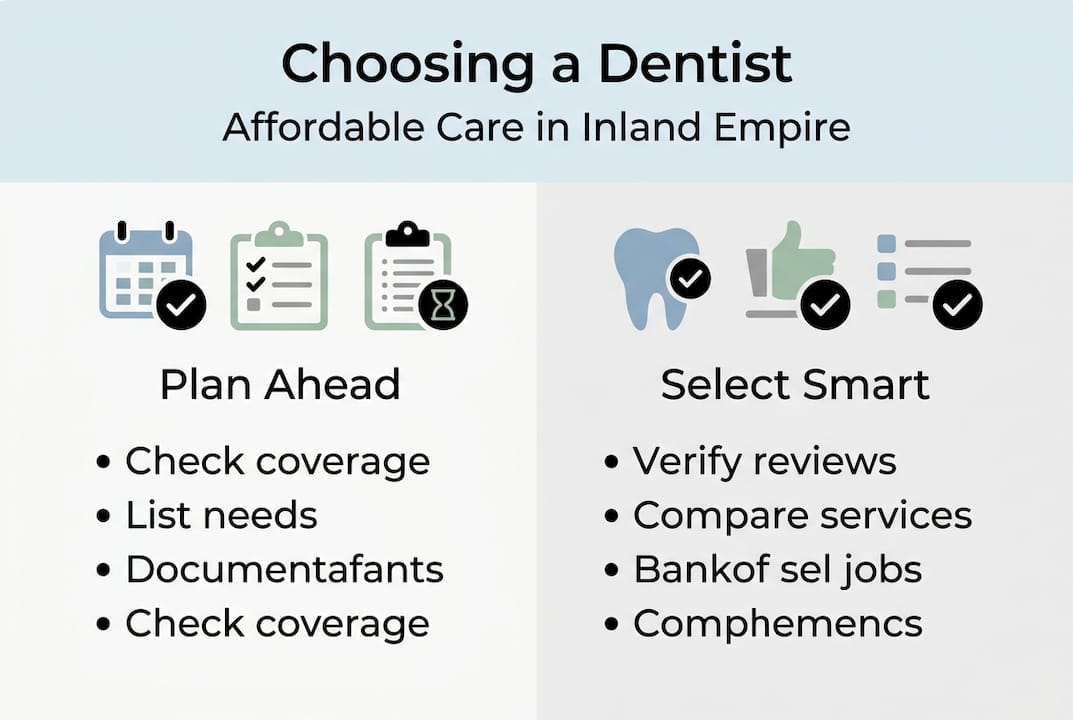
A fresh perspective: What truly matters when picking a dentist in Inland Empire
Most guides stop at price comparisons and insurance checklists. We think that’s only half the story. After working with thousands of patients across the Inland Empire, we’ve seen one factor make or break a long-term dental relationship: trust.
You can find a dentist who accepts your plan and charges reasonable fees, but if the communication feels rushed or the staff seems indifferent, you’ll delay appointments. You’ll avoid follow-ups. Your oral health will quietly slip. That’s the real cost no fee schedule captures.
The best dental relationships are built on clear communication, consistent care, and an office that remembers who you are. For families, this matters even more. When your children feel comfortable at the dentist, they carry that positive association into adulthood.
We’ve seen real patient care stories where patients drove past closer offices simply because they found a provider who took the time to explain every step. That’s not a luxury. That’s what good care looks like. When you evaluate your options, give weight to how the office made you feel on that first call. It tells you more than any star rating.
Affordable care options in Inland Empire: Next steps
You’ve done the research. Now it’s time to act. At Monteluz Dental Specialty Group in San Bernardino, we’ve built our practice around exactly the needs this guide covers: Denti-Cal acceptance, in-house membership programs starting at $20 per month for uninsured patients, bilingual support, and specialty services all under one roof.
Whether you’re exploring understanding local membership programs for your household, looking into affordable orthodontic services for your children, or researching dental implant options for yourself, we’re here to help you find the right fit. Schedule a consultation with our team and let us show you what patient-centered, affordable dental care actually feels like.
Frequently asked questions
How can I confirm if a dentist accepts Denti-Cal or Medi-Cal?
Use the SmileCalifornia or DHCS provider search to find listed providers, then call the office directly to confirm current acceptance before booking your appointment.
What can I do if I don’t have dental insurance?
Look for dentists offering in-house memberships, sliding scale fees, or flexible payment plans. Many offices, including those listed on accessible dental care options, help uninsured patients access quality care at manageable costs.
Should I choose a dentist based on lower cost or more services?
Balance both. A lower cost means little if the office can’t handle your family’s full range of needs. Prioritize offices with positive reviews, clear pricing, and comprehensive services that match what you actually need.
How do I know if a dentist is right for my family?
Look for providers with strong patient reviews, clear communication during your first call, and a full range of family-friendly services including pediatric care and flexible scheduling.
Are bilingual dental offices available in Inland Empire?
Yes. Many dental offices in the region offer bilingual English and Spanish support. Use official state directories and ask specifically about language services when you call to confirm availability.
Recommended
- Accessible Dental Care 2026: Options For Inland Empire Families
- General Dentistry for Affordable Family Care Inland Empire
- Access bilingual dental services in Inland Empire 2026
- Orthodontics for oral health: affordable options in Inland Empire
- Blog Articles | Chameleon